
A Framework for Peace in Ukraine
Jeffrey D. Sachs / October 22, 2026
Summary
The war in Ukraine can be brought to a permanent end on terms that protect Ukraine's statehood, meet Russia's security concerns, and lay the foundation for a durable European security order. In this brief I propose a comprehensive framework in fourteen parts. It would take effect as a permanent end of hostilities on signature and would be implemented in stages under international verification. Its core consists of four commitments: NATO would end its enlargement eastward, Ukraine would adopt permanent neutrality, the two sides would establish an armistice line with de facto jurisdiction on each side and a mutual renunciation of force in any future adjustment of the line, and Ukraine would pursue its candidacy for membership in the European Union as a permanently neutral state.
Around that core the framework sets out the provisions needed to make the settlement work and to answer the objections of all parties. Ukraine would advance its accession negotiations with the European Union as a permanently neutral state, and no forces of the European Union, of NATO, or of their member states would be stationed on Ukrainian territory. A special demilitarized zone would be established in the part of Donetsk region that Ukraine now controls, a Northern Security Zone would be demilitarized on both sides of the Russian-Ukrainian border, and Russia would withdraw from the areas it holds outside the four regions it claims. Forces and long-range strike systems would be subject to mutual and verified limits, and a Black Sea regime would secure free commercial navigation and naval restraint. Rights of language, education, culture, and religion would be guaranteed according to European standards and applied reciprocally on both sides of the line. The Organization for Security and Co-operation in Europe would be revived as the common institution of European security. Prisoners of war would be exchanged on an all-for-all basis and separated children reunited with their families. Russia's immobilized sovereign assets would be released, private property seized or immobilized on both sides would be restored, normal diplomatic relations would be resumed, and an international fund would finance reconstruction in the war-affected regions. All sanctions would be lifted, and Russia's immobilized assets released in full, in stages completed no later than 31 December 2027, the United Nations Security Council would vote to adopt the settlement by resolution, the settlement would be guaranteed jointly by the five permanent members of the Security Council together with additional guarantor states, and ratification would proceed in a sequence compatible with the constitutions of both Ukraine and Russia.
The Present Moment
The negotiations have reached a dangerous stalemate. In October 2026 American and European officials were reported to be preparing a new plan with four components: a freeze of positions along the current line of contact, security guarantees for Ukraine that a U.S. official described as effectively equivalent to Article 5 of the North Atlantic Treaty, a process and timetable for lifting sanctions together with an energy arrangement in which transit revenues would be shared between Kyiv and Moscow, and a reconstruction fund involving the World Bank and private investors.1 Moscow has rejected a temporary ceasefire, including the 60-day ceasefire proposed by President Zelensky, and on 10 October President Putin told President Trump that an immediate resumption of trilateral talks was unlikely.2 Reports attributed to sources close to the Kremlin indicate that Russia intends to complete the capture of Donetsk region before it negotiates in earnest, although the Kremlin has dismissed such reports as speculation.3
Russia's stated position has been consistent in its essentials. In June 2024 President Putin set out the conditions for a ceasefire as Ukraine's withdrawal from the four regions that Russia claims and Ukraine's renunciation of NATO membership. The Russian memorandum presented at Istanbul on 2 June 2025 restated these terms. At Yekaterinburg on 16 September 2026 Foreign Minister Sergey Lavrov said that a settlement required the achievement of the original objectives of the special military operation, and he identified three root causes of the conflict: NATO's plans to move closer to Russia's borders, including its military infrastructure; the oppression of Russians; and Ukrainian state policy directed against the Russian language, education, media, and culture.4
The American-European plan and the framework proposed here share one essential element, which is the freeze of the line of contact. They differ on the means of providing security. A guarantee to Ukraine equivalent to Article 5, given by the United States and European states, would be read in Moscow as NATO's commitment extended to Ukraine under another name, and it would reproduce the condition that the settlement is meant to remove. The plan also leaves aside two of the three root causes that Russia names, and it offers no answer to the question of Donetsk, over which the fighting continues. The framework below is designed to fill these gaps. It substitutes neutrality and a joint guarantee of the settlement for a guarantee against one party. It offers a formula for Donetsk. It answers Russia's concerns about language and religion with European standards that Ukraine must meet in any event on its path to the European Union, and it places the settlement within a revived system of European security.
Principles of the Settlement
The first principle is indivisible security. The Helsinki Final Act of 1975 and the Charter of Paris of 1990 established that security in Europe is indivisible, and the OSCE Istanbul Charter of 1999 and the Astana Declaration of 2010 affirmed that each state is free to choose its security arrangements while committing each state not to strengthen its security at the expense of the security of others.5 The settlement applies this principle to Ukraine, to Russia, and to the rest of Europe, and wherever possible it places obligations on both sides rather than on one.
The second principle is that the settlement should establish de facto arrangements without requiring either party to violate its constitution. Article 73 of the Constitution of Ukraine provides that changes to the territory of Ukraine may be decided only by an all-Ukrainian referendum, and Article 157 forbids amendment of the Constitution under martial law. Article 67 of the Constitution of the Russian Federation, as amended in 2020, prohibits actions aimed at the alienation of any part of Russia's territory, which under Russian law now includes the four regions annexed in September 2022. A settlement that required either side to cede or to recognize territory de jure would therefore fail on constitutional grounds before it was signed. An armistice line with de facto jurisdiction, combined with a mutual renunciation of force, is the formula that is compatible with both constitutions. The Korean Armistice Agreement of 27 July 1953 has kept the peace on this basis for more than seven decades.
The third principle is reciprocity. Each party will rightly ask what the others offer in return for its own undertakings, and the framework is built so that every major undertaking is matched. NATO ends its enlargement eastward, and Ukraine adopts permanent neutrality and withdraws its forces from the Donetsk Special Zone. Russia withdraws from the areas it holds outside the four regions it claims, accepts on the record Ukraine's membership in the European Union, and joins a revived OSCE and a wider regime of military restraint in Europe. Both Ukraine and Russia demilitarize a Northern Security Zone on their respective sides of the border, accept mutual limits on forces and missiles, and both guarantee the rights of language, education, culture, and religion on their respective sides of the line according to the same standards.
The fourth principle is that the settlement is a single package. No element would be negotiated or implemented in isolation, and no party would be asked to make a concession in advance of signature. The settlement would take effect as a permanent end of hostilities on signature, while its detailed provisions are implemented in stages tied to verified compliance. The sequence matters because the political provisions, including Ukraine's constitutional change, its elections, and the lifting of sanctions, cannot all take place at once, and because each side must see the other perform before it takes the next step. The model is the General Framework Agreement for Peace in Bosnia and Herzegovina of 1995, a short framework treaty to which detailed annexes were attached and whose military provisions were implemented on a fixed timetable.
Part I. The End of NATO Enlargement Eastward
The North Atlantic Council would adopt a declaration that NATO will not admit Ukraine, Georgia, Moldova, Armenia, or Azerbaijan, and that it renounces further enlargement toward the borders of Russia. The declaration would withdraw paragraph 23 of the Bucharest Summit Declaration of April 2008, which stated that Ukraine and Georgia "will become members of NATO," together with the related language of the Vilnius Summit Communiqué of July 2023 and the Washington Summit Declaration of July 2024, which described Ukraine's path to membership as irreversible.6 Naming the states concerned removes the ambiguity of a general reference to "the east" and settles the question for the whole belt of non-member states between NATO and Russia. The declaration would be registered with the Secretary-General of the United Nations and incorporated in the Security Council resolution adopting the settlement, so that it carries the weight of a formal undertaking by states. The membership of Finland and Sweden, which joined the Alliance in 2023 and 2024, would not be affected.
The North Atlantic Council would adopt this declaration as an integral part of the settlement, at its signature, and the declaration would take effect together with the settlement. The declaration costs the Alliance little, since NATO has declined for eighteen years to act on the Bucharest pledge and several Allies opposed that pledge in 2008. Russia has placed NATO enlargement first among the causes of the war since it published its draft treaties of December 2021, and a settlement that resolves this question directly, rather than deferring it, gives Russia a reason to conclude the war and to keep the peace.
Article 10 of the North Atlantic Treaty provides only that the parties may, by unanimous agreement, invite another European state to accede. It confers a discretion on the members, not an entitlement on any applicant, and NATO is therefore free to decide that it will issue no further invitations to the states on Russia's borders. Moldova's Constitution already proclaims the country's permanent neutrality, and the settlement would recognize and respect that status.
Part II. The Permanent Neutrality of Ukraine
Ukraine would declare its permanent neutrality in a constitutional law, following the model of Austria's Federal Constitutional Law on Neutrality of 26 October 1955. Ukraine would undertake not to join any military alliance, not to permit the establishment of foreign military bases on its territory, and not to permit the stationing of foreign military forces on its territory. The prohibition would apply to the forces of NATO, of the European Union and its member states, of Russia, and of any other state or coalition, and it would cover reassurance forces, trip-wire forces, training missions, and military advisers. The only foreign military personnel present in Ukraine would be accredited defense attachés and the unarmed observers of the international monitoring mission described in Part XIII. Russia would undertake the corresponding obligation to respect Ukraine's neutrality and not to station or introduce its forces on the territory under Ukrainian jurisdiction.
Neutrality restores the founding commitment of the Ukrainian state. Ukraine's Declaration of State Sovereignty of 16 July 1990 proclaimed its intention to become a permanently neutral state that does not take part in military blocs, and the Verkhovna Rada wrote Ukraine's non-bloc status into law in July 2010. Neutrality does not mean disarmament. Ukraine would retain armed forces for its own defense within the mutual limits set out in Part V, and it would remain free to acquire weapons for its defense from any supplier, subject to those limits. Ukraine would also remain free to choose its government, its economic system, and its trading partners, and to join the European Union.
The guarantors of the settlement would acknowledge Ukraine's neutrality, as the four occupying powers and then the states with which Austria maintained diplomatic relations acknowledged Austria's neutrality in 1955 and 1956. They would undertake to respect Ukraine's neutrality, independence, and the inviolability of the armistice line, and to refrain from any action that would undermine them, including interference in Ukraine's internal political life.
Part III. Ukraine’s Membership in the European Union on the Basis of Permanent Neutrality
Ukraine's candidacy for membership in the European Union, which the European Council granted in June 2022, is the fourth core element of the settlement, and Ukraine would pursue it as a permanently neutral state. Austria, Ireland, and Malta are already neutral member states, and the European treaties accommodate their status. Article 42(7) of the Treaty on European Union obliges member states to aid a member state that is the victim of armed aggression on its territory "by all means in their power," but it adds that this obligation "shall not prejudice the specific character of the security and defence policy of certain Member States." Ukraine's accession treaty would include a protocol on Ukraine's neutrality, modeled on the Protocol on the Concerns of the Irish People on the Treaty of Lisbon of 2012, which confirmed that the Treaty of Lisbon did not affect Ireland's traditional policy of military neutrality.7 The protocol would state that Ukraine's membership does not alter its permanent neutrality, that Article 42(7) applies to Ukraine in conformity with that neutrality, and that no military forces of the Union or of its member states will be stationed in Ukraine under the Common Security and Defence Policy or under any other arrangement.
Under the protocol Ukraine would take part in the Union's civilian, economic, humanitarian, and crisis-management activities, but not in military operations or in projects of permanent structured cooperation that involve the deployment of forces. Ukraine would remain free to take part in the Union's industrial and procurement programs for its own defense needs, within the limits of Part V. The European Union and Russia would affirm, in an exchange of letters annexed to the settlement, that Ukraine's membership in the Union is consistent with its neutrality and with the security interests of Russia. Russian officials have said on several occasions that Ukraine's accession to the European Union is a matter for Ukraine and the Union to decide, and the exchange of letters would place that position on the formal record.
Membership in the European Union would give neutrality real economic content. Austria's neutrality was accompanied by steady economic integration with Western Europe, and Austria joined the Union in 1995 as a neutral state. A neutral Ukraine within the Union would be a bridge between the Union and Russia rather than a front line. The settlement would therefore provide for negotiations between the European Union and the Eurasian Economic Union on trade, transit, and technical standards, so that Ukraine's accession does not sever the economic ties of the regions on both sides of the armistice line.
Part IV. The Armistice Line, the Donetsk Special Zone, and the Northern Security Zone
The armistice line would be the line of contact on a reference date fixed in the framework agreement, which would be the date of its signature. Within 72 hours of signature the military commanders of both sides would exchange maps of the line, and the monitoring mission would record any discrepancies for resolution by the Joint Military Commission described in Part XIII. Fixing the line by a reference date, rather than at the end of a long negotiation, removes the incentive for either side to launch offensives to improve its position before signature. The Korean experience is instructive in this respect. From July 1951 to July 1953, while the armistice was under negotiation, both sides fought costly battles over the line that the agreement would eventually fix.
Each side would exercise de facto jurisdiction on its side of the line. The settlement would state expressly that nothing in it constitutes recognition by either party of the territorial claims of the other, and that the final status of the territories concerned shall be determined only by peaceful means. Both sides would renounce the use or threat of force to change the line. Russia's constitutional claims to the parts of Zaporizhzhia and Kherson regions that it does not control, including the cities of Zaporizhzhia and Kherson, and Ukraine's claims to the territories under Russian control, including Crimea, would be subject to the same provisions. This formula leaves intact the legal position and the constitution of each party, while removing territory from the battlefield.
The remaining territorial question concerns the part of Donetsk region that Ukraine still controls, including the cities of Kramatorsk and Sloviansk. I propose that this area become a Donetsk Special Zone. Ukrainian armed forces would withdraw from the zone, Russian armed forces would not enter it, and the zone would be demilitarized under the observation of the monitoring mission. The existing local civil administration and public services would continue to function, residents would be free to remain or to leave with their property and pensions protected, and the final status of the zone would be left to negotiation under the renunciation of force.
The arrangement gives both parties the political cover they need. Russia can say that Ukraine's armed forces have left the whole of Donetsk region, which is its principal military objective there, without a further year of costly fighting. Ukraine can say that it has ceded no territory and that its cities remain under their own civil administration, and neither side recognizes the claims of the other. In return for the Ukrainian withdrawal, Russia would withdraw its forces from the areas it holds in Dnipropetrovsk region and from the Kinburn Spit in Mykolaiv region, and these areas would return to Ukrainian administration within the demilitarized belt of Part V. In Kherson region, where the line of contact runs along the Dnipro River, the islands of the lower Dnipro would be demilitarized.
Russia has stated that it requires a security zone along its northern border with Ukraine, a concern that Ukraine's incursion into Kursk region in August 2024 and the strikes on Russia's border regions made concrete. Ukraine has the mirror-image concern about Russian forces massed along the same border, from which part of the offensive toward Kyiv was launched in February 2022 and the offensive toward Kharkiv in May 2024. The settlement would therefore establish a Northern Security Zone on both sides of the international border between Russia and Ukraine, from the tripoint with Belarus to the armistice line, covering the border districts of Chernihiv, Sumy, and Kharkiv regions in Ukraine and of Bryansk, Kursk, and Belgorod regions in Russia. Within an agreed depth on each side of the border neither party would maintain military formations, heavy weapons, or long-range strike systems, and only border guards and police under agreed limits would be present. Russian forces would withdraw from the areas they hold in Kharkiv and Sumy regions at the same time as Ukrainian forces withdraw from the Ukrainian side of the zone, under verification by the monitoring mission, and these areas would return to Ukrainian civil administration. The zone meets Russia's requirement for security along its northern border through mutual demilitarization rather than occupation, and it gives Ukraine the same protection in return.
The Zaporizhzhia Nuclear Power Plant, the largest nuclear power plant in Europe, has been under Russian control since March 2022 and has hosted a continuous presence of the International Atomic Energy Agency since September 2022. Under the settlement the plant would remain under Russian control and operation. The IAEA presence would continue, with responsibility for nuclear safety and security oversight, and the plant and its immediate surroundings would be demilitarized. Any restart of the plant's reactors would take place under IAEA safety supervision. The plant would supply electricity to both parties under a long-term offtake arrangement: Ukraine would purchase an agreed share of the plant's output at cost, meaning a price that covers the plant's operating, maintenance, and safety costs without a profit margin, delivered through the restoration of the transmission lines that connect the plant to the Ukrainian grid, and the remainder would supply the territories on the Russian-controlled side of the line. The offtake arrangement would give both parties a continuing stake in the plant's safe operation and in the maintenance of the peace. A joint commission would address water supply from the Dnipro basin for the regions on both banks of the river and for Crimea.
Part V. Demilitarization and Mutual Limits on Forces
The settlement would establish a demilitarized belt on both sides of the armistice line. Within an agreed distance on each side, which I suggest should be on the order of 15 kilometers, neither side would maintain military forces other than border guards and police under agreed limits. Within a wider band, heavy weapons, artillery, and multiple-launch rocket systems would be withdrawn, and within a still wider band long-range strike systems, including ballistic and cruise missiles and long-range attack drones, would be prohibited. The Minsk II agreement of February 2015 provided for the withdrawal of heavy weapons to create a security zone at least 50 kilometers wide, and up to 140 kilometers wide for the longest-range rocket systems.8 The experience of its implementation showed that such provisions require continuous and well-equipped verification, which Part XIII provides.
Beyond the demilitarized belt, the settlement would establish mutual ceilings on forces in a Zone of Limitation comprising the regions on both sides of the armistice line and of the international border between Russia and Ukraine, including the regions of the Northern Security Zone. The ceilings would cover active-duty personnel, main battle tanks, armored combat vehicles, artillery, combat aircraft, and attack helicopters, on the model of the Treaty on Conventional Armed Forces in Europe of 1990, and they would be set at levels that allow Ukraine a credible defense while removing the capacity of either side to mount large-scale offensive operations. The overall size of Ukraine's armed forces was the principal point of disagreement at Istanbul in April 2022, when Russia proposed a ceiling of 85,000 personnel and Ukraine proposed 250,000. The American plan of November 2025 proposed a ceiling of 600,000.9 I propose that the ceiling on Ukraine's peacetime forces be set within this range by negotiation, and that it be paired with the reciprocal ceilings on forces in the border regions on both sides, so that Ukrainians experience the limits as a regime of mutual security rather than as a unilateral imposition.
The settlement would also limit missile ranges. The Istanbul draft of April 2022 already contained provisions of this kind, though the two sides were far apart on the permitted range. Under the settlement neither side would deploy ground-launched missiles above an agreed range within the Zone of Limitation, and Ukraine would not acquire such missiles. The parties would establish a regime of annual data exchange, advance notification of exercises above agreed thresholds, and short-notice inspections, building on the Vienna Document of the OSCE. In the event of an armed attack confirmed by the monitoring mission, the limits would cease to bind the party attacked.
Part VI. The Black Sea and the Sea of Azov
Russia's Black Sea Fleet has been based at Sevastopol since the eighteenth century, and Ukraine's economy depends on the export of grain, oilseeds, and metals through Odesa and the other ports of the northwestern Black Sea. The Black Sea is therefore the area in which Russia's security concerns and Ukraine's economic interests meet most directly. The settlement would guarantee freedom of commercial navigation to and from all Ukrainian and Russian ports in the Black Sea and the Sea of Azov, including passage through the Kerch Strait, and it would prohibit attacks on merchant shipping and on port infrastructure. The two sides would conduct joint mine clearance with the assistance of Turkey, Romania, and Bulgaria, which have cooperated in mine countermeasures in the western Black Sea since 2024.
Consistent with Ukraine's neutrality, no foreign naval forces would be based in Ukrainian ports, and Ukraine's naval forces would be limited to coastal defense within agreed ceilings, including limits on uncrewed surface and underwater strike vessels. Russia would accept corresponding limits on the deployment of its Black Sea Fleet in the northwestern Black Sea. All parties would reaffirm the Montreux Convention of 1936, which governs passage through the Turkish Straits and limits the presence in the Black Sea of warships of non-littoral states. The settlement would also provide for an agreement on the prevention of incidents at sea and in the air, modeled on the U.S.-Soviet Agreement on the Prevention of Incidents On and Over the High Seas of 1972, to which Turkey, Romania, Bulgaria, and Georgia would be invited to adhere.
The Black Sea also offers a field for cooperation that can give the settlement a positive economic foundation. The Organization of the Black Sea Economic Cooperation, founded in 1992, includes Russia, Ukraine, Turkey, Georgia, Romania, and Bulgaria among its members, and it could serve as the framework for joint projects in offshore wind, electricity interconnection, green fuels, port modernization, and the environmental restoration of the sea.
Part VII. A European Layer of Mutual Restraint
A settlement confined to Ukraine would leave in place the wider military competition that contributed to the war. The settlement would therefore be accompanied by reciprocal undertakings between NATO and Russia, negotiated in parallel and adopted at the same time. The first would be a moratorium on the deployment in Europe of ground-launched missiles with ranges between 500 and 5,500 kilometers, the class of weapons banned by the Intermediate-Range Nuclear Forces Treaty until its expiry in 2019. The moratorium would cover the stationing of U.S. long-range fires in Germany announced in 2024 and Russian deployments of such missiles in Belarus and Kaliningrad, including the Oreshnik system. Russia proposed a moratorium of this kind after 2019, and the parties would negotiate verification measures that include the Mk-41 launchers at the Aegis Ashore sites in Romania and Poland, which Russia regards as capable of firing offensive cruise missiles.
The second undertaking would concern nuclear weapons and force posture. NATO and Russia would each undertake not to deploy nuclear weapons on the territory of any state where they are not deployed today, and they would open negotiations on the nuclear weapons stationed in Belarus and in the states that take part in NATO's nuclear-sharing arrangements. They would also open negotiations on conventional force posture along their common border, taking as their point of departure the undertakings of the NATO-Russia Founding Act of 1997.10
The third undertaking would restore the channels of communication that the war destroyed. The parties would re-establish the NATO-Russia Council as a forum for consultation, restore direct military-to-military communication, and conclude agreements on the prevention of dangerous military incidents in the Baltic Sea region, where the transit to and from Kaliningrad and the density of military activity carry a constant risk of escalation.
The settlement would also restore normal diplomatic relations on both sides. Russia and Ukraine would re-establish diplomatic relations, and Russia, the member states of the European Union, and the United States would restore the normal staffing of their embassies and consulates, return diplomatic property, resume direct air links, and normalize visa procedures on a reciprocal basis.
Part VIII. The Revival of the OSCE
The OSCE is the only European security institution in which Russia, Ukraine, the United States, Canada, and all the states of Europe and Central Asia sit as equals, and it is the institutional heir of the Helsinki Final Act and the Charter of Paris. Since 2022 the organization has been largely paralyzed by disputes over its budget, its leadership, and the participation of Russia, and its Special Monitoring Mission to Ukraine, which reported on the line of contact from 2014, ceased operations in March 2022. The settlement offers the occasion to restore the OSCE to the role that the Charter of Paris envisaged for it, as the common institution of a Europe whose security is indivisible.
I propose that the parties and the guarantors convene an OSCE summit of heads of state and government, the first since the Astana summit of 2010, to endorse the settlement and to adopt a new Charter of Indivisible Security. Switzerland, which holds the OSCE chairmanship in 2026 and has long experience as a protecting power and mediator, is well placed to prepare such a summit together with its successors in the chairmanship. The summit would entrust the OSCE with four responsibilities in the implementation of the settlement. It would host the international monitoring mission described in Part XIII. Its Forum for Security Co-operation would serve as the venue for negotiating and verifying the mutual force limits of Part V, for modernizing the Vienna Document, and for negotiating a successor to the Treaty on Conventional Armed Forces in Europe, which Russia formally left in 2023 and which NATO's members then suspended. The High Commissioner on National Minorities and the Office for Democratic Institutions and Human Rights would oversee the rights provisions of Part IX on both sides of the line. The Office for Democratic Institutions and Human Rights would also observe the Ukrainian elections provided for in Part XIV.
The summit would restore the organization's normal functioning, including the regular adoption of its unified budget and the full participation of all participating states in its institutions. A revived OSCE would also provide the standing framework for the wider dialogue on European security that the settlement in Ukraine should begin, including the questions of Moldova and Transnistria and of the South Caucasus, and the arrangements of Part VII for mutual military restraint.
Part IX. Rights According to European Standards
Russia names the treatment of Russian speakers and of the Russian language, education, media, culture, and Orthodox Church in Ukraine among the root causes of the war. These concerns can be addressed by applying the European standards that Ukraine has accepted and that it must meet on its path to membership in the European Union. Ukraine ratified the Council of Europe's Framework Convention for the Protection of National Minorities in 1998, the European Charter for Regional or Minority Languages entered into force for Ukraine in 2006, and Ukraine is a party to the European Convention on Human Rights. The Venice Commission has issued opinions critical of aspects of Ukraine's education law of 2017 and its state language law of 2019, and the European Union made the protection of national minorities one of the conditions for opening accession negotiations, to which Ukraine responded with amendments to its law on national minorities in December 2023.11 Hungary has pressed the same issues on behalf of the Hungarian minority in Transcarpathia.
Under the settlement Ukraine would undertake to implement the opinions of the Venice Commission and the recommendations of the Advisory Committee on the Framework Convention regarding the use of minority languages in education, media, public life, and local administration, with the Russian language treated on the same basis as the other minority languages of Ukraine. Ukraine would guarantee freedom of religion under Article 9 of the European Convention on Human Rights, and the law of August 2024 on religious organizations affiliated with the Russian Orthodox Church would be reviewed by the Venice Commission and brought into conformity with its findings.12 These obligations would be monitored by the Council of Europe and the OSCE High Commissioner on National Minorities, and they would form part of the European Commission's assessment of Ukraine's progress toward accession. Ukraine would thus meet Russia's concerns on terms that it can defend as its own European commitments rather than as concessions extracted under pressure.
Russia would undertake corresponding obligations on its side of the line. Residents of the territories under Russian de facto jurisdiction would enjoy the right to education in the Ukrainian language, the free use of Ukrainian in private and public life, freedom of religion for the Orthodox Church of Ukraine, the Ukrainian Greek Catholic Church, and all other communities, and freedom from coercion in matters of citizenship and personal documents. Because Russia ceased to be a member of the Council of Europe in March 2022, these obligations would be written into the settlement itself and monitored by the OSCE High Commissioner on National Minorities and by a Joint Commission on Human Rights whose independent members would be drawn from neutral states.
All obligations concerning extremism, incitement, and hatred would be fully mutual, defined according to agreed European standards, and monitored by the OSCE. Both parties are bound by the International Convention on the Elimination of All Forms of Racial Discrimination, Article 4 of which obliges states parties to condemn and prohibit propaganda and organizations that promote racial hatred, and both are participating States of the OSCE, whose commitments on tolerance and non-discrimination they have accepted. The settlement would commit both parties, on identical terms, to implement these obligations, to combat incitement to hatred against Russians, Ukrainians, and all other national groups, and to refrain from the official glorification of persons and organizations responsible for crimes against humanity. The OSCE Office for Democratic Institutions and Human Rights and the High Commissioner on National Minorities would monitor implementation on both sides of the line and report to the Joint Political Commission. This reciprocal undertaking addresses, in the terms of established European standards and on an equal footing for both sides, the concern that Russia has expressed under the heading of denazification.
Part X. Humanitarian Provisions
The settlement would provide for the exchange of all prisoners of war on an all-for-all basis within 60 days of signature, together with the release of civilians detained in connection with the conflict. A Joint Commission on Missing Persons, working with the International Committee of the Red Cross, would establish the fate of the missing and arrange the return of remains. The parties would establish, with the assistance of the ICRC, UNICEF, and the mediators who have already facilitated the return of children, including Qatar and the Holy See, a verified registry of children separated from their families or moved across the line, and they would arrange the reunification of each child with family members or legal guardians in accordance with the best interests of the child. Ukrainian authorities have registered roughly 20,000 such cases.13 Families divided by the line would be guaranteed the right to visit one another and to reunite.
The parties would grant a mutual amnesty for participation in hostilities and for acts of cooperation with the authorities of the other side, so that soldiers and civilians on both sides can return to ordinary life. Customary international humanitarian law encourages the broadest possible amnesty at the end of hostilities, with the exception of persons suspected of war crimes.14 The question of accountability for serious violations is the more difficult one. I propose that the parties establish a joint commission on the conduct of the war, with independent members, to document violations by all sides, and that they agree with the guarantors on how judicial proceedings will be handled in a manner consistent with the peace. Article 16 of the Rome Statute allows the Security Council to request the International Criminal Court to defer an investigation or prosecution for renewable periods of twelve months, and the Council could consider such a request in the resolution adopting the settlement.
Part XI. Sanctions, Sovereign Assets, and Reconstruction
The sanctions imposed on Russia since 2014, and above all since February 2022, would be lifted in three stages during 2027, and in any case no later than 31 December 2027, and Russia would lift its countermeasures in parallel. The first stage, upon completion of the disengagement from the demilitarized belt and the exchange of prisoners, would restore civil aviation links, lift the restrictions on trade in agricultural products and fertilizers and on the associated payments, and reconnect the relevant Russian banks to international payment systems. The second stage, upon completion of the withdrawals of Part IV and the full deployment of the monitoring mission, would lift the restrictions on energy trade and on financial transactions more broadly. The third stage, upon ratification of the settlement and the entry into force of the force limits of Part V, would lift the remaining sanctions. The stages would follow the implementation calendar of Part XIV, but the final date is fixed: the settlement is not intended to place Russia under open-ended conditionality or the permanent supervision of the Western powers, any more than it places Ukraine under such supervision. Questions of implementation raised by either party would be resolved through the Joint Military Commission, the Joint Political Commission, and consultations among the guarantors, which bind Ukraine and Russia equally. The European Union adopted its twentieth package of sanctions in April 2026, and Europe has borne a large share of the economic cost of the sanctions regime, so the phased lifting of sanctions serves Europe's economic interest as well as the settlement.
The Russian sovereign assets immobilized since February 2022, amounting to roughly $300 billion, of which more than €200 billion are held in the European Union and most of that at Euroclear in Belgium, would be released to their owner in tranches synchronized with the three stages of sanctions relief, with the final tranche released no later than 31 December 2027. The confiscation of sovereign reserves, or their use without the consent of the state that owns them, would damage the international monetary system and the reserve role of the euro, and it would leave a lasting grievance at the heart of the settlement. Ukraine and Russia would both take part in the reconstruction fund described below, which finances reconstruction on both sides of the line. Russia, like the European Union, the United States, and the other contributors, would make a contribution to the fund as a participant in a common reconstruction effort rather than as reparations. The amount would be negotiated as part of the settlement and could be paid from the assets as they are released. The treatment of the windfall profits on the immobilized assets that have already been used to support Ukraine would be settled in the same negotiation, and Russia and the states holding the assets would each waive further claims arising from the immobilization.
Private property would be restored on both sides on the same timetable. The European Union and the other states concerned would release the private assets of Russian persons and companies frozen under sanctions, and Russia would end the temporary management of the assets of European and other foreign companies and restore them to their owners. Each side would release the property of the other's nationals in parallel, with the process completed no later than 31 December 2027.
An International Fund for the Reconstruction of Ukraine and the War-Affected Regions would be established as a multi-donor trust fund administered by the European Investment Bank, the bank of the European Union, with the participation of the European Bank for Reconstruction and Development and the Asian Infrastructure Investment Bank, the last of which would facilitate contributions from China, India, the Gulf states, and other donors outside the West. Placing the fund in the European Investment Bank would anchor Ukraine's reconstruction in the institutions of the Union that Ukraine is to join, and it would align the fund's investments with the standards and procurement rules of the accession process. The fund would have two windows. The larger window would finance reconstruction in the territory under Ukrainian jurisdiction, in coordination with the European Union's Ukraine Facility and with Ukraine's accession program. A second window would finance humanitarian reconstruction on the Russian-controlled side of the line, including housing, hospitals, schools, water, and power, under the same standards of transparency and audit. Financing would come from the European Union, the United States, Russia, other public donors, and private investment mobilized through guarantees, as envisaged in the American-European plan of October 2026. The fund would operate under strict safeguards against corruption, including independent audit and public reporting of every disbursement, which donors and the Ukrainian public will rightly demand.
The settlement would also restore economic links that the war severed. The transit of Russian gas through Ukraine, which ended on 1 January 2025, would be permitted to resume under a new commercial contract wherever there are willing buyers, with transit fees paid to Ukraine. The settlement would not commit the European Union or any of its member states to purchase Russian gas; whether to do so would remain a decision for each buyer and each government. The longer-term economic foundation would rest on electricity interconnection, cross-border trade in renewable power, and the Black Sea cooperation described in Part VI.
Part XII. A Joint Guarantee of the Settlement
A durable settlement does not depend on a guarantee given to one party against another. It depends on the mutual recognition by both parties of each other's security, embodied in obligations that both accept and that impartial monitors verify. A guarantee of the kind proposed in the American-European plan, under which the United States and European states would respond militarily to a renewed Russian attack, would be read in Moscow as Article 5 extended to Ukraine, and it would reopen the question that the settlement is designed to close.
I propose instead that the settlement be adopted by a vote of the United Nations Security Council and guaranteed jointly by the permanent members of the Security Council, Russia included, together with additional guarantor states. At Istanbul in March 2022 the two delegations discussed a list of guarantor states that included the five permanent members of the Security Council together with Canada, Germany, Israel, Italy, Poland, and Turkey. The guarantors would be the five permanent members of the Security Council, namely China, France, Russia, the United Kingdom, and the United States, together with Germany, Italy, and Turkey. India and other states would be invited to join as guarantors if they so choose. The Security Council as a whole would vote to adopt the settlement by a resolution under Chapter VII of the Charter, so that the guarantee given by its permanent members is joined to the authority of the Council itself. The guarantors would undertake to respect the settlement, Ukraine's neutrality, and the armistice line, and to consult within 72 hours upon a report by the monitoring mission of a serious violation. The Istanbul negotiations faltered in part over whether a single guarantor could block a collective response. The settlement would resolve this question by making the findings of the monitoring mission, rather than the consent of any one guarantor, the trigger for consultations among the guarantors and for referral to the Security Council, whichever party the violation concerns. In the event of an armed attack confirmed by the monitoring mission, the limits of Part V would cease to bind the party attacked, and the guarantors would be free to assist it in the exercise of its inherent right of self-defense under Article 51 of the Charter of the United Nations.
Ukraine's security would thus rest on its own armed forces within the agreed limits, on the demilitarized belt, the Donetsk Special Zone, and the Northern Security Zone, on continuous international verification, and on the political and economic costs that either party would incur by breaching a settlement adopted by the Security Council and guaranteed by its five permanent members together with the additional guarantor states. Russia's security would rest on Ukraine's neutrality, the end of NATO enlargement, the absence of foreign forces in Ukraine, and the mutual limits on forces and missiles.
Part XIII. Verification and Implementation
An International Monitoring Mission would be established under the OSCE, with the endorsement and support of the United Nations. It would consist of unarmed civilian and military observers drawn from states that are not members of NATO, including civilian observers from the neutral states of Europe, such as Switzerland, Austria, and Ireland, and observers from states such as India, Brazil, Indonesia, South Africa, and Kazakhstan whose impartiality both parties can accept. No military units of any NATO or EU member state would be deployed in Ukraine. The OSCE Special Monitoring Mission of 2014 to 2022 was hampered by restrictions on its access, by limited technical means, and by the absence of any mechanism that obliged the parties to act on its reports. The new mission would have guaranteed freedom of movement on both sides of the line, its own satellite imagery, long-range uncrewed aerial surveillance, and acoustic and radar sensors along the line, and its reports would be transmitted simultaneously to the parties, the guarantors, and the Security Council.
A Joint Military Commission of the two parties, chaired by the head of the monitoring mission, would meet regularly to resolve incidents, oversee the disengagement and the withdrawals, and maintain direct communication between the commanders of the two sides. A Joint Political Commission, with the participation of the guarantors, would oversee the implementation of the civil, humanitarian, rights, and economic provisions of the settlement.
Part XIV. Sequencing, Ratification, and Legitimacy
The settlement would be concluded as a short Framework Agreement for Peace in Ukraine, signed by Ukraine and Russia and witnessed by the guarantors, that is, the five permanent members of the Security Council and the additional guarantor states, with detailed annexes on the armistice line, the Donetsk Special Zone, military limitations, the Black Sea, rights, humanitarian matters, sanctions and assets, reconstruction, verification, and the guarantee. Hostilities would cease permanently on all fronts 72 hours after signature, and the Security Council would vote to adopt the agreement by a resolution under Chapter VII of the Charter, so that its obligations bind all member states of the United Nations. Implementation would then proceed in the stages set out in the table below.
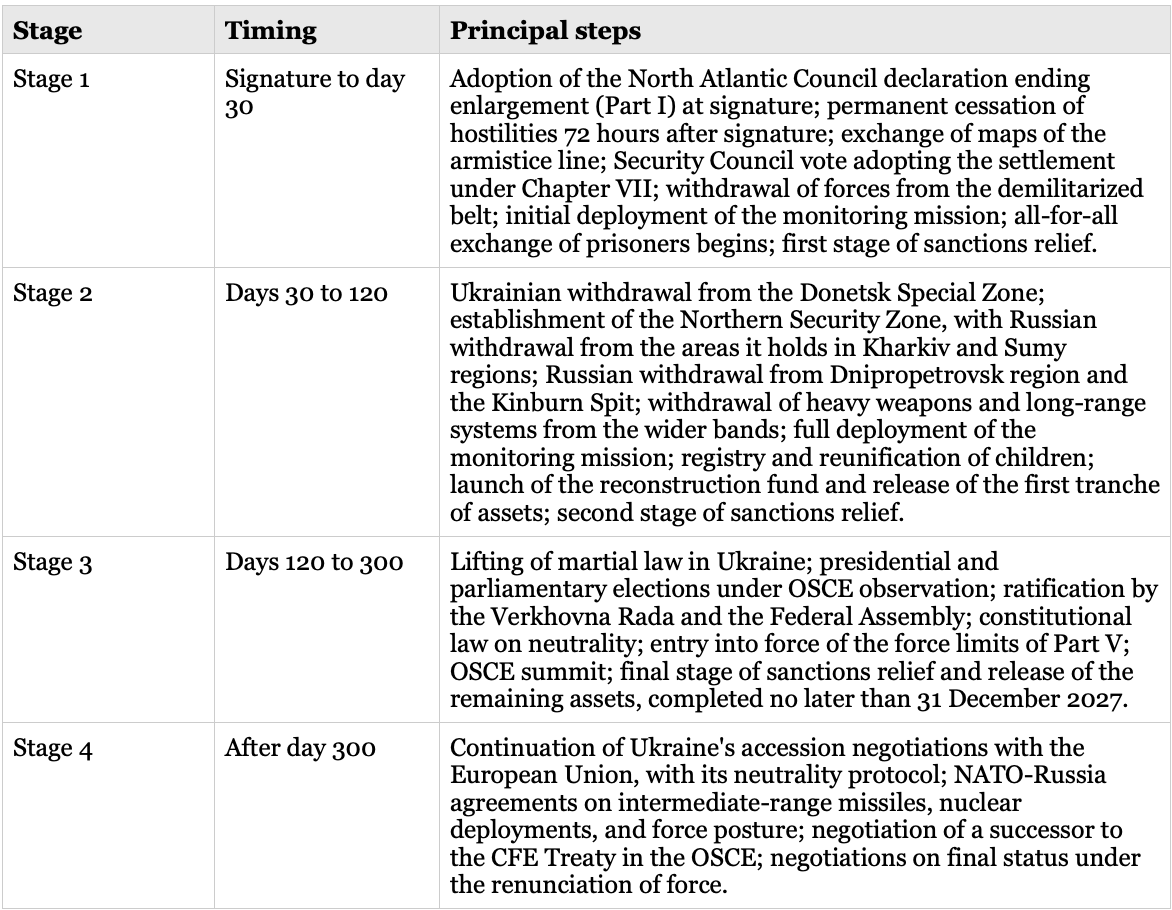
The constitutional sequence in Ukraine requires particular care. Article 157 of the Constitution of Ukraine forbids constitutional amendment under martial law, and the amendments of February 2019 inscribed the goal of NATO membership in the preamble and in Articles 85, 102, and 116. Martial law would therefore be lifted once the disengagement is complete, and presidential and parliamentary elections would be held under OSCE observation. The newly elected Verkhovna Rada would ratify the settlement, adopt the constitutional law on permanent neutrality, and amend the provisions adopted in 2019. Because the settlement transfers no territory de jure, it does not require a referendum under Article 73. The Federal Assembly of the Russian Federation would ratify the settlement at the same stage. This sequence also answers the Russian argument that the present Ukrainian authorities lack the mandate to conclude a lasting settlement, since the settlement would be ratified by newly elected institutions.
Recommendations for European Governments
European governments should propose within the North Atlantic Council a declaration ending NATO enlargement to Ukraine, Georgia, Moldova, Armenia, and Azerbaijan, conditional on the entry into force of a settlement, and they should make clear to Washington and Kyiv that they will support such a declaration as the centerpiece of the settlement. They should drop the demand for an unconditional ceasefire as a precondition for negotiation and support instead a framework agreement that takes effect as a permanent end of hostilities on signature. In the American-European plan they should replace the proposed guarantee equivalent to Article 5 with Ukraine's neutrality and a settlement adopted by vote of the Security Council and guaranteed jointly by its five permanent members, Russia included, together with additional guarantor states, and they should rule out the stationing in Ukraine of any forces of the European Union, NATO, or their member states.
The European Union should affirm Ukraine's candidacy for membership as a permanently neutral state, with a neutrality protocol on the Irish model, and it should commit to the standards of the Council of Europe on language, education, and religion as part of that path. It should prepare the lifting of its sanctions and the release of Russia's immobilized assets in stages completed no later than 31 December 2027, and it should take the lead, through the European Investment Bank, in establishing the international reconstruction fund. European governments should open direct diplomatic channels with Moscow on the wider European security order, beginning with a moratorium on intermediate-range missiles and the restoration of the NATO-Russia Council, and they should work with the Swiss chairmanship of the OSCE to convene a summit that endorses the settlement and restores the organization as the common institution of European security. Europe has been largely absent from the design of the settlement so far. By putting forward a framework that addresses the causes of the war, European governments can move to the center of the negotiation and help to end a war that has already cost hundreds of thousands of lives and that carries a continuing risk of direct confrontation between nuclear powers.
Notes
1. David Ignatius, The Washington Post, as reported in "The Washington Post: U.S. and Europe are developing a new plan to end the Russia-Ukraine war," Meduza, 14 October 2026, https://meduza.io/en/feature/2026/10/14/the-washington-post-u-s-and-europe-are-developing-a-new-plan-to-end-the-russia-ukraine-war-offering-incentives-and-security-arrangements-in-exchange-for-a-ceasefire-along-the-current-front-line; "US and Europe Draft Peace Framework That Freezes Frontline and Sets Terms for Russia Sanctions Relief," UNITED24 Media, October 2026, https://united24media.com/war-in-ukraine/us-and-europe-draft-peace-framework-that-freezes-frontline-and-sets-terms-for-russia-sanctions-relief-23386.
2. "Putin tells Trump peace talks are unlikely, cites Ukraine drone attacks," Al Jazeera, 10 October 2026, https://www.aljazeera.com/news/2026/10/10/putin-tells-trump-peace-talks-are-unlikely-cites-ukraine-drone-attacks.
3. "Kremlin no longer willing to return any occupied Ukrainian territory as part of potential peace deal, Bloomberg reports," Meduza, 22 July 2026, https://meduza.io/en/news/2026/07/22/kremlin-no-longer-willing-to-return-any-occupied-ukrainian-territory-as-part-of-potential-peace-deal-bloomberg-reports.
4. Vladimir Putin, address at the Ministry of Foreign Affairs of the Russian Federation, 14 June 2024, Kremlin transcript; memorandum of the Russian delegation, Istanbul, 2 June 2025; "Ukrainian Settlement Requires Fulfillment of Original Special Military Op Goals: Lavrov," TASS, 16 September 2026, https://tass.com/politics/2188477.
5. Conference on Security and Co-operation in Europe, Final Act, Helsinki, 1 August 1975; Charter of Paris for a New Europe, 21 November 1990; OSCE, Charter for European Security, Istanbul, November 1999; OSCE, Astana Commemorative Declaration: Towards a Security Community, 3 December 2010.
6. NATO, Bucharest Summit Declaration, 3 April 2008, paragraph 23; NATO, Vilnius Summit Communiqué, 11 July 2023; NATO, Washington Summit Declaration, 10 July 2024.
7. Treaty on European Union, Article 42(7); Protocol on the Concerns of the Irish People on the Treaty of Lisbon, signed 13 June 2012, entered into force 1 December 2014.
8. Package of Measures for the Implementation of the Minsk Agreements, 12 February 2015, endorsed by United Nations Security Council Resolution 2202 (2015).
9. Samuel Charap and Sergey Radchenko, "The Talks That Could Have Ended the War in Ukraine," Foreign Affairs, 16 April 2024; "More details of US plan for Ukraine emerge, sees territory ceded to Russia," Al Jazeera, 21 November 2025, https://www.aljazeera.com/news/2025/11/21/more-details-of-us-plan-for-ukraine-emerge-sees-territory-ceded-to-russia.
10. Founding Act on Mutual Relations, Cooperation and Security between NATO and the Russian Federation, Paris, 27 May 1997.
11. European Commission for Democracy through Law (Venice Commission), Opinion on the Provisions of the Law on Education of 5 September 2017, CDL-AD(2017)030, December 2017; Venice Commission, Opinion on the Law on Supporting the Functioning of the Ukrainian Language as the State Language, CDL-AD(2019)032, December 2019; European Commission, Ukraine 2023 Report, SWD(2023) 699, 8 November 2023.
12. Law of Ukraine No. 3894-IX, "On the Protection of the Constitutional Order in the Sphere of Activities of Religious Organizations," adopted 20 August 2024.
13. Government of Ukraine, "Children of War" portal, https://childrenofwar.gov.ua.
14. International Committee of the Red Cross, Customary International Humanitarian Law, Rule 159; Rome Statute of the International Criminal Court, Article 16.